

STNDRD Deviations Columnist Discovers His Cheesy Destiny
“I’m at fault in all my relationships,” said Corey Levitan, STNDRDS’ humor columnist, as we peered at a loose slice of Sargento Swiss cheese. I’d just told him his future using that piece of cheese during a recent Zoom session. We learned that his intuition is strong, but he doesn’t always listen to it the first time; a relationship in his life will need to be nurtured more soon; he’s about to put up an emotional wall; and within four months, he will experience uncertainty.
I deduced these things based on the following shapes, in order: a hole that’s half covered by a small amount of cheese; an otter floating on its back; a shadowy line on the cheese; and a ragged edge at the top of the slice.
Next I showed Levitan a piece of pepper jack cheese and told him to ask a yes-or-no question. I answered with a “yes” after the letter Y appeared prominently in the cheese.
I may be the only person in the world currently telling fortunes with cheese, but I’m definitely not the first. The practice is called tyromancy, and the first written mention of it dates back to the second century. Professional diviner Artemidorus of Daldis wrote about tyromancers in one of his dream-interpretation books. He stated that the practitioners of tyromancy were essentially in league with the devil—alongside dice diviners, sieve diviners and necromancers.
Like most forms of divination, tyromancy took hold in the Middle Ages, a time when religion ruled everything. People were looking for a way to find out and affect their future that was supposedly destined for them by God.
Like most forms of divination, one of the main uses was to determine who to choose as a partner and marry. Girls in countryside English villages glommed onto cheese divination at that point, carving names of potential suitors into various pieces of cheese. The one that molded first was apparently their true love.
Tyromancy then expanded and was used to answer questions about potential children and ensuring safe passage on a trip. It even was utilized to give crops a fighting chance by offering cheese to fairies. Often practiced in Scotland, it was supposedly believed fairies have a historically voracious appetite for all things dairy.
The practice of tyromancy began to diminish around 1670. The last written mention of it for several hundred years was an appearance that casually noted it was a common word of the day with no other information. Interestingly, this was during the rise of the witch trials when many folk fortune-telling methods disappeared, never to return. Except for tyromancy, which I’ve brought back as an experience for the soothsayer fanatics of today.
Ultimately, I suggested to Levitan that he invest in some self-care and give himself a chance to tease out the reason behind the upcoming uncertainty. After the reading, he told me that the relationship aspect we discussed made complete sense to him. He revealed he has a family relationship that needs some extra care and handling it could lead him into uncharted waters.
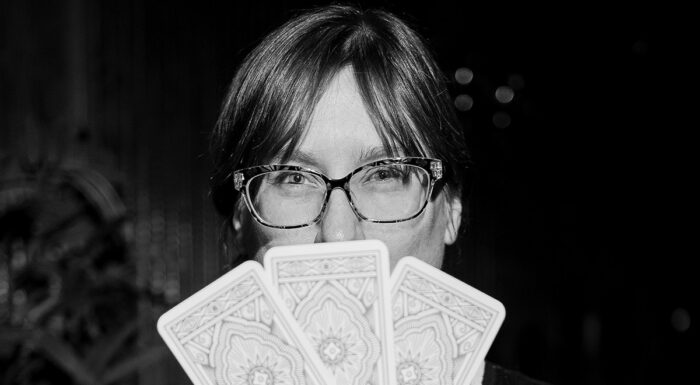
We concluded our session with a conversation about psychics and divination itself, and how it’s truly impossible to say with certainty that these practices aren’t real—no matter what point of view anyone else tries to impress on you.
“I’m a person of science,” Levitan said, “but science doesn’t even know what consciousness is. It can’t even explain why we’re alive. Some scientists think that it’s quantum entanglement inside the neurons creating a cohesion—no one knows! … Who’s to say what’s real and not real?”
As an open-minded skeptic myself, I go into a divination session with someone reading for me fully expecting them to say something nonsensical. So I can appreciate Levitan’s take. We don’t fully know how our brain works, how we ended up here, or what the essence of life even is. So why can’t mediums, psychics and diviners exist? Why should we automatically dismiss the concept? Maybe the truth really is in the cheese.