

What would you do if your hot neighbor suggested you join them for some group sex? What if that neighbor were Penélope Cruz?
That’s exactly the premise of The Invite, Olivia Wilde’s third feature film as a director. Rashida Jones and Will McCormack, comedy veterans who have been friends for decades, wrote the screenplay.
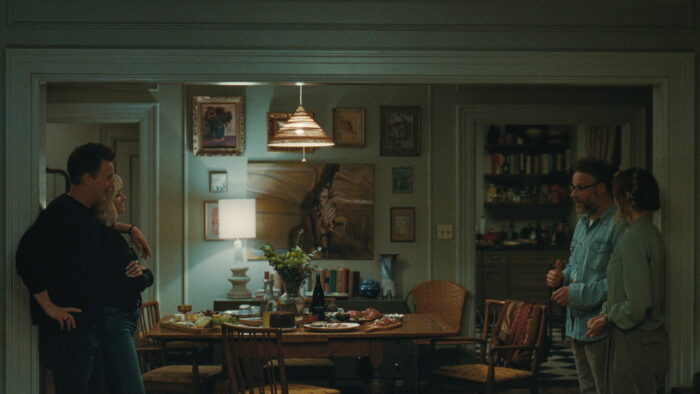
The tightly paced relationship comedy takes place in an apartment over the course of a single night with only four actors. Wilde and Seth Rogen play Angela and Joe, a straightlaced couple in a struggling marriage; Cruz and Edward Norton play Piña and Hawk, their kooky, sexy neighbors.
Often described as Who’s Afraid of Virginia Woolf? with group sex, The Invite debuted to rave reviews, a strong box office performance and even some Oscar buzz. It has even been added to many critics’ “best of the year so far” lists. The Invite is also sparking conversation about group sex and ethical nonmonogamy—particularly because it doesn’t portray nonmonogamy as the end of a relationship, a rarity in media depictions of that relationship style.

While Cruz and Norton bring plenty of laughs—like the reveal that Hawk is legally named Howard—Piña and Hawk’s relationship itself isn’t a joke. Their connection is portrayed as strong, though unconventional. Their open communication style, lack of jealousy and celebration of compersion—taking enjoyment in their partner’s pleasure with someone else—fascinates their neighbors and, likely, the audience.
Throughout a chaotic night filled with charcuterie, flan, soft swinging and an ill-timed back injury, Hawk and Piña go with the flow while Angela and Joe’s marriage reveals all its cracks until it shatters.
That’s not to say that Hawk and Piña are perfect. They do have a few moments of bickering, but they quickly apologize and make up. Angela and Joe, however, hold so much resentment toward each other that it’s basically a fifth character. And this contrast is stark: Angela and Joe haven’t had sex in a year; Piña and Hawk have loud, orgasmic sex parties every weekend.
When nonmonogamy is portrayed on film, it’s often shown as a sign of the end of a marriage—like in the 2025 comedy Splitsville—rather than something that could potentially strengthen a couple’s bond. For some nonmonogamous people, seeing Hawk and Piña portrayed as solidly in love—even if they’re a little offbeat—felt refreshing.
“I kept expecting that Hawk and Piña would become the punchline, or be revealed as villains of some sort, because that’s usually how poly or nonmonogamous people are treated in movies. But that didn’t happen,” one man in an open marriage told The Nod magazine.
A woman in a nonmonogamous relationship added, “Hawk and Piña’s characters aren’t treated like freaks or cult members who have joined some kind of movement. They simply have a relationship that works for them.”
Polyamory is far more common in real life than it is onscreen. The 2024 Match Singles in America report found that about one-third of single Americans have had a consensually nonmonogamous relationship. And less than half said that traditional monogamy is their ideal sexual relationship.
Others preferred some form of ethical nonmonogamy—on a spectrum from monogamous with some sexual or romantic variety in some circumstances to polyamory, which is having more than one open romantic relationships at a time.
A 2025 study in the “Journal of Sex Research” found that nonmonogamous couples are just as happy with their love lives as monogamous couples and a little more sexually satisfied, though not significantly.
“While monogamy works well for many, others find connection, fulfillment, and wellbeing through nonmonogamous relationships,” an author of the 2025 study told The Guardian.
Swinging—when couples swap partners—as in The Invite is having a moment right now among young people, with rising visibility on social media. “Sex recession, who? Meet the young couples bringing back swinging,” reads one Cosmopolitan headline from June, citing “swingers getting off at themed events or fancy dress parties in sex clubs, searching for play partners on apps like Feeld, and arranging meet-ups via community-centered Telegram groups—and, crucially, most of them will be in their 20s and 30s.”
In an interview with Dazed, Norton joked that the movie should be played at “swingers conventions.”
Wilde said in the same interview she’s surprised and thrilled that for all the talk of a Gen Z sex recession, the movie is finding a young audience that’s interested in or experienced with nonmonogamy.
She said college students “were like, ‘This feels really relevant.’ One guy, who’s 19, goes, ‘This really brought up some conversations I need to have with my partner.’”
The kids are alright—and nonmonogamous.