Social Media Has a Fierce Grip on Many—But Not All
If the mere mention of the movie Everything Everywhere All at Once makes your heart pound, you’re not alone. While the Oscar-winner might have been about parallel realities simultaneously colliding, the expression hits a little close to home for many. And not in a good way.
“There is a pressure to be everywhere now, and it isn’t accidental,” said Matt Navarra, a UK-based social media consultant who has worked with Google, Meta and the BBC, among others. “I think it’s a bit of a perfect storm.”
And a perfect storm it is. In the quest to be ever visible and ever present, the average internet user is now active across nearly seven social media platforms each month, according to DataReportal’s “Digital 2025: The State of Social Media in 2025.” Meanwhile, Deloitte’s 2025 Digital Media Trends survey found that Gen Z respondents spent 54 percent more time than the average consumer per day on social platforms and user-generated content.
It appears that what was once a handful of platforms and moments has expanded into a constant, overlapping, never-ending stream of content and conversation. It’s something that’s always on, making it increasingly difficult to step away from.
From Curated to Content
What’s changed from social media’s infancy in the mid-2000s isn’t just the sheer number of platforms. It’s not even how much content exists but rather how that content is created, distributed and expected to perform.
“You’ve got platforms like TikTok, Instagram and even LinkedIn all competing for cultural dominance, and they’re all rewarding constant participation—not just showing up but showing up fast and frequently and in the right format,” Navarra said.
This is a distinct change from how social media used to work, where individuals and brands showed up only when they had something to say, something to contribute. In other words, when they were relevant.
“You can spot the shift when a brand starts shape-shifting to fit every trend,” Navarra continued. “Their tone changes depending on what’s popular; their content feels more reactive rather than intentional, and you struggle to describe what they’re actually standing for.”
The end result? Everything feels muddy. Blurry. Interchangeable. When that happens, the perception of that individual or brand also can change. Suddenly, they’re viewed as opportunistic. Thirsty. Overexposed.
This produces more than a simple eye roll or scroll-past from followers. It creates distrust. Brands posted an average of 9.5 times per day across networks in 2024, according to Sprout Social. The social media analytics firm noted that all this content has contributed to what it calls a state of “social media saturation.”
Audiences are showing signs of strain as well. A 2025 survey from the American Psychiatric Association found that half of adults have actively limited their social media use, while other studies show users are increasingly likely to unfollow brands that post too frequently or chase irrelevant trends.
“I think audiences are much more attuned to this now than they ever were, and they can spot opportunism instantly; especially when brands jump on every meme or every cause or cultural moment without a clear connection back to their identity, and that’s when overexposure kicks in,” Navarra stated.
Absence Becomes Aspirational
Overexposure may be the outcome of too much social media, but fear of missing out (FOMO) is the driver.
“Underneath all of that is fear,” Navarra said. “There’s a very real sense that if you’re not part of the conversation, you’re irrelevant. I think that’s why it feels more intense now because the cost of not showing up feels higher than ever.”
That fear doesn’t just apply to brands. It shows up in our personal lives as well. The pressure to keep up with a stream of content that constantly reminds us someone else has a better life, cooler places to be and more friends to hang out with has created a persistent sense that we’re not simply missing out, but that we’re just not good enough.
That’s when FOMO can quickly morph from a fleeting pang we feel as we scroll, to lower overall well-being, increased exhaustion and ultimately burnout. The more we spend our time, energy and money trying to portray that aspirational lifestyle, the bigger burnout may be.
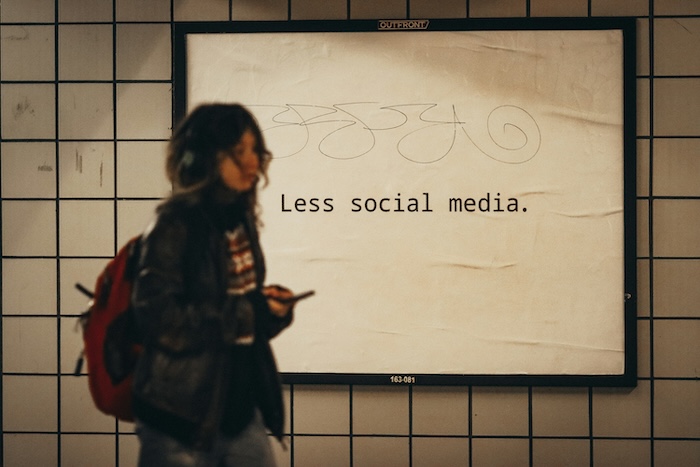
Here’s the thing, though. Being “always on” has jumped the shark. What’s becoming aspirational now is not showing up.
“Opting out is starting to look like a power move,” Navarra said.
The strategy now is more intentional. Choosing to come to social media when you have something to say.
“A strategic absence does signal confidence in some instances,” he continued. “It tells audiences you know who you are, and you’re not chasing everything.”
So perhaps it’s the quiet voice that speaks the loudest and says the most nowadays.
“In an always-on culture, restraint is what creates signal,” Navarra added. “Everything else is just noise.”